
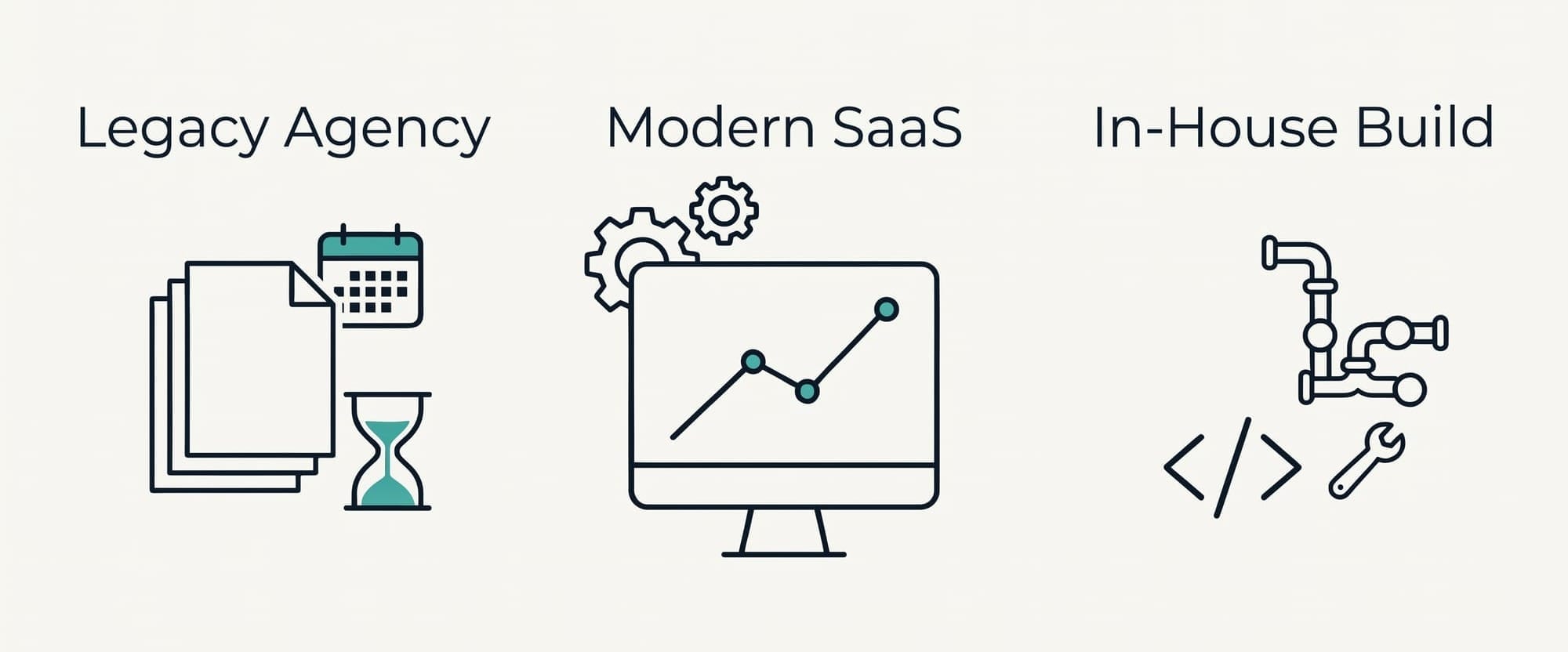
World-class open-source libraries such as PyMC Marketing, Google Meridian, and Meta Robyn have commoditised the mathematics of Marketing Mix Modelling (MMM). Most professional data science teams can therefore develop effective MMMs and choosing a solution depends on value-added capabilities such as automatic data ingestion, time to first model, model validation, decision cadence and ease of use.
In this post, we explore what each approach looks like in practice and which kinds of businesses they are best suited for.
Legacy Consultancy
Legacy consultancies have dominated the enterprise MMM space for over 30 years. Typically, an external team of econometricians / data scientists builds a custom model, charges between $150,000 and $400,000, and delivers a static slide deck alongside a scenario-planning tool.
The main advantage is a bespoke model tailored to the nuances of an specific business but an equally significant drawback is that readouts arrive with a 4 to 6-month lag. By the time the model arrives, the market has shifted and the model becomes a measure of the past rather than an actionable forecast of the future.
Coupled with the fact that model validation via lift testing is often relegated to in-house teams, allocating media spends with confidence and defending it to scrutiny from the finance department remains a challenge. Finally, the business remains dependant on the external consultancy to re-run scenarios or test new budget distributions.
- Best suited for: Large enterprise conglomerates spending $100M+ across fragmented global markets and offline retail, where an annual board-level governance audit is sufficient.
Modern SaaS
Modern SaaS platforms develop MMMs with semi-automated, expert-in-the loop processes and charge $20,000 to $150,000 per year making them accessible to both enterprise and mid-market businesses.
Leading SaaS platforms usually deliver an always-on MMM within 1 to 2 months without compromising on customisations unique to the business. This speed is achieved by significantly automating data ingestion & cleaning which historically consumed up to 80% of modelling time.
Weekly inference keeps insights aligned with the actual pace of media buying, and when the platform supports lift tests, model validation makes it highly actionable and defensible.
A subtle advantage is that modern platforms provide intuitive scenario-planning interfaces that allow non-technical marketers and growth leads to simulate allocations without writing Python code or waiting on an external analyst.
Our view is that legacy econometrics agencies will increasingly shift toward high-touch SaaS models as software and open-source tooling proliferate across the industry.
- Best suited for: High-growth brands and modern media agencies with spends from $500K to $100M+ annually that reallocate budget weekly or monthly and need rapid, transparent scenario planning.
In-House Build
Contrary to intuition, an in-house build using free open-source libraries is usually the most expensive and high-risk path for the vast majority of companies because, for most businesses, it requires developing a completely new competency in data engineering, data science and software engineering.
While doing so leads to a highly customised model that integrates with internal systems well, an always-on build might take 6-9 months for the first model. Even a minimal in-house team of 1 data scientist, 1 data engineer & 1 software engineer represents a fully-loaded annual payroll of $400,000 to $600,000+, alongside infrastructure and compute overhead.
More critically, in-house projects suffer from an acute "bus factor": if the lead data scientist who developed the model leaves, the code frequently turns into unmaintainable shelfware. Additionally, because marketing departments rarely receive priority capacity from internal engineering teams, broken data pipelines can stall model updates for weeks at a time.
- Best suited for: Giants spending $100M+ with massive, permanent data infrastructure teams and bespoke business mechanics that off-the-shelf software cannot capture.
Summary
| Metric | Legacy Consultancy | In-House Build | Modern SaaS |
|---|---|---|---|
| Annual Cost | $150k – $400k+ | $400k – $600k+ (Salaries + Compute) | $30k – $150k |
| Time-to-First-Model | 4 – 6 Months | 6 – 9 Months | 1 – 2 Months |
| Update Frequency | Half-Yearly or Annually | As required | Weekly |
| Data Ingestion | Manual CSVs & wrangling | Internal ETL | Automated connectors & warehouse sync |
| Interface | Static Slide Deck + Scenario Planning Tool | Jupyter Notebooks & Streamlit | Interactive Dashboards & Scenario Planners |
| Risk | High Vendor Lock-in | High "Bus Factor" (team turnover) | Low (open source), High (closed source) |
For most modern businesses, SaaS represents the most rational path forward for MMM and incrementality measurement.
By eliminating the 6-9-month setup lag and handling the pipelines for automated data ingestion, SaaS provides the two things growth teams actually need to drive business outcomes: decision velocity to match active campaign pacing, and an intuitive interface that enables non-technical marketers to allocate spends with confidence.
chat_bubble Comments & Discussion